
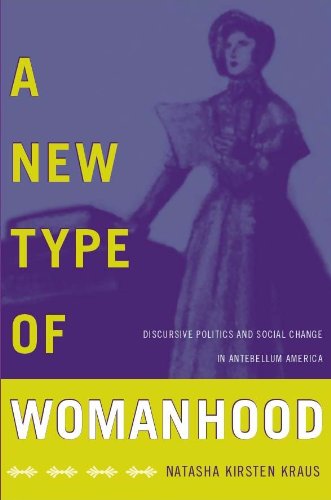
A New Type of Womanhood: Discursive Politics and Social Change in Antebellum America
Product details
| Management number | 232006823 | Release Date | 2026/06/18 | List Price | US$7.90 | Model Number | 232006823 | ||
|---|---|---|---|---|---|---|---|---|---|
| Category | |||||||||
In A New Type of Womanhood, Natasha Kirsten Kraus retells the history of the 1850s woman’s rights movement. She traces how the movement changed society’s very conception of “womanhood” in its successful bid for economic rights and rights of contract for married women. Kraus demonstrates that this discursive change was a necessary condition of possibility for U.S. women to be popularly conceived as civil subjects within a Western democracy, and she shows that many rights, including suffrage, followed from the basic right to form legal contracts. She analyzes this new conception of women as legitimate economic actors in relation to antebellum economic and demographic changes as well as changes in the legal structure and social meanings of contract.Enabling Kraus’s retelling of the 1850s woman’s rights movement is her theory of “structural aporias,” which takes the institutional structures of any particular society as fully imbricated with the force of language. Kraus reads the antebellum relations of womanhood, contract, property, the economy, and the nation as a fruitful site for analysis of the interconnected power of language, culture, and the law. She combines poststructural theory, particularly deconstructive approaches to discourse analysis; the political economic history of the antebellum era; and the interpretation of archival documents, including woman’s rights speeches, petitions, pamphlets, and convention proceedings, as well as state legislative debates, reports, and constitutional convention proceedings. Arguing that her method provides critical insight not only into social movements and cultural changes of the past but also of the present and future, Kraus concludes A New Type of Womanhood by considering the implications of her theory for contemporary feminist and queer politics. Read more
Bestseller ranking
Personal Injury

Customers who viewed this product also viewed
Antebellum


Correction of product information
If you notice any omissions or errors in the product information on this page, please use the correction request form below.
Correction Request Form